

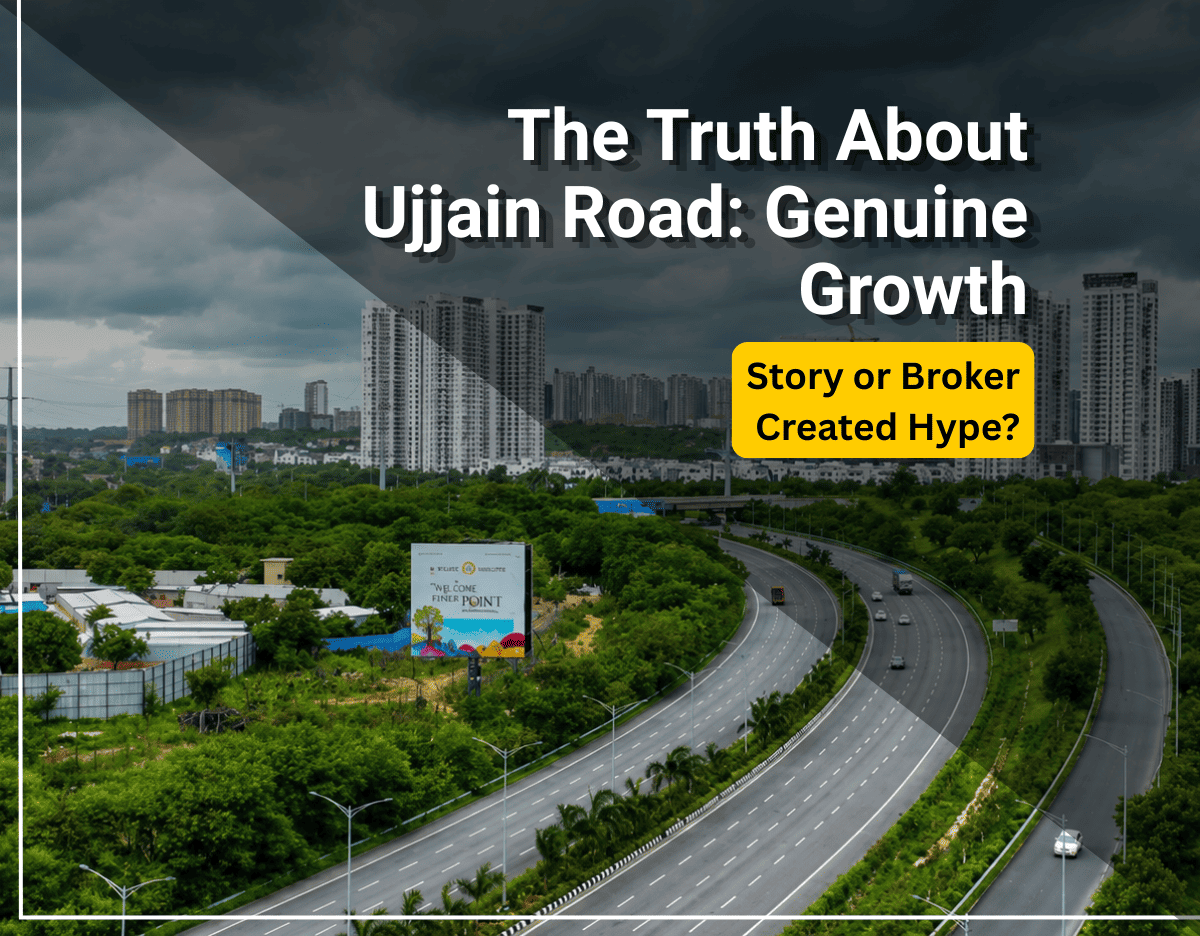
Few stretches around Indore generate as much conflicting advice as Ujjain Road. One camp calls it the most obvious opportunity of the decade. The other camp dismisses it as a belt inflated by aggressive selling before a religious event. Both camps quote convincing arguments, which is exactly why an honest, evidence-based breakdown is needed. This article separates what is verifiably happening on this corridor from what is being added on top by marketing, so you can judge the stretch on facts rather than noise.
What Is Verifiably Real
The infrastructure spending on this corridor is not a rumour. The 1,692 crore rupee six-lane highway between Indore and Ujjain has been reported as nearly complete, cutting travel time on one of the region’s most used routes. The state government has confirmed that 148 development projects worth 16,910 crore rupees are in progress across Ujjain and surrounding districts ahead of Simhastha 2028, the once-in-12-year gathering scheduled from March to May 2028, for which official estimates project pilgrim numbers in the tens of crores. A Namo Bharat rapid rail connection between Indore and Ujjain has been approved, and the government has directed fast-track approvals for hotel and hospitality projects across the Indore-Ujjain region.
The administrative layer matters just as much. The state formally created the Indore Ujjain Metropolitan Region and, in June 2026, expanded it further by adding Dhar, Nagda, and Ratlam. Regions do not receive metropolitan planning status for a two-month festival. This is a long-horizon urban integration plan, and the corridor connecting its two anchor cities sits at the centre of it.
Affordability completes the genuine case. Listing portal data from mid 2026 places average rates on the Ujjain Road belt near 3,500 rupees per square foot, which keeps it among the most accessible entry points in the Indore market. When a corridor combines the lowest base prices with the region’s highest confirmed infrastructure spending, the growth logic is real, and the appetite for residential property in indore has visibly started spilling toward this belt as buyers get priced out of the eastern hotspots.
Where the Hype Begins
Now the uncomfortable half. Confirmed infrastructure does not automatically make every project on the corridor a good buy, and this is where selective storytelling takes over.
The first inflation technique is event framing. Simhastha 2028 is real, but some sellers imply that prices will multiply by the festival and that buyers must rush. Historical evidence from event-driven markets tells a more sober story. Infrastructure built for large gatherings creates permanent value, but speculative premiums built purely on the event often correct once it passes. The highway, the rail link, and the metropolitan planning will matter in 2032. The festival crowd itself will not.
The second technique is distance stretching. Projects located 8 or 10 kilometres off the main alignment borrow the corridor’s name while offering none of its access. The value being created is concentrated along the highway, the proposed rail nodes, and the planned urban schemes, not across every farm in the district.
The third is approval blur. Fast-track hospitality approvals announced by the government apply to specific categories of projects, yet the phrase gets borrowed loosely in sales pitches for layouts that hold no such clearances. On a fast-moving corridor, unapproved and partially approved layouts multiply quickly, and experienced real estate consultants in indore consistently report that this stretch produces more documentation problems than the city’s established zones, simply because supply is being created faster than scrutiny.
The Honest Verdict
Ujjain Road is a genuine growth story wearing a coat of hype. The infrastructure, the metropolitan planning, and the price base are all real and all favourable. The exaggeration lies in the timelines promised, the distances hidden, and the approvals implied. Treat the corridor as a five-to-ten-year infrastructure play rather than a two-year festival bet.
Practical rules for this stretch are simple. Stay within a reasonable distance of the main highway alignment. Insist on T&CP approval, RERA registration, and clean diversion papers with zero flexibility. Compare the quoted rate against the corridor average near 3,500 rupees per square foot and demand justification for large premiums. Buyers who follow these rules are participating in a real regional shift. Buyers who skip them are funding someone else’s marketing budget, on a road where the difference between the two is only visible in the paperwork.
